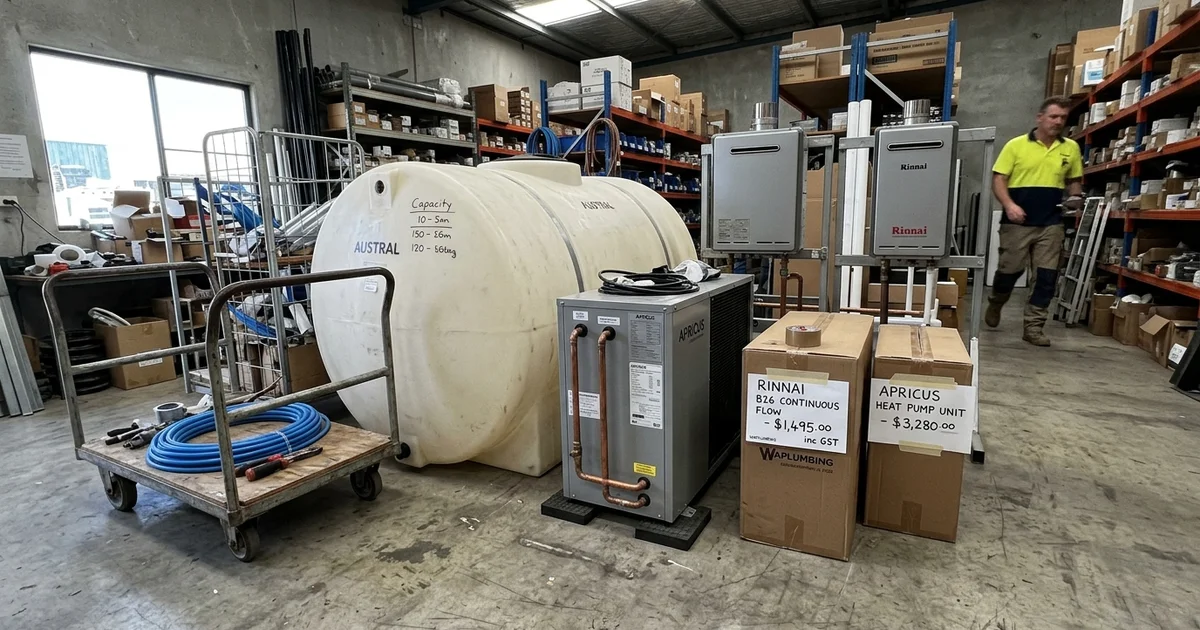
What a hot water system costs across Western Australia
Hot water pricing in WA follows a consistent pattern once you separate the unit from the installation, which is exactly how we structure a hot water system installation quote. Here is the realistic supplied-and-installed range across the state, before rebates.
| System type | Installed range | Typical lifespan |
|---|---|---|
| Electric storage | $500 - $2,500 | 8 - 12 years |
| Gas storage | $900 - $2,200 | 8 - 12 years |
| Continuous flow gas | $1,400 - $3,200 | 15 - 20 years |
| Solar (close-coupled or split) | $2,500 - $6,500 | 15 - 20 years, collectors longer |
| Heat pump | $2,500 - $5,500 | 10 - 15 years |
Two general points hold across the whole range. Cheaper to buy almost always means dearer to run. And the systems with the longest service life sit toward the top of the table, which changes the annualised cost more than most people expect.

Unit price by brand and capacity
Within each type, the unit price moves with capacity and brand positioning.
Electric storage. A compact 50 to 80 litre unit sits at the bottom. A 125 to 170 litre family tank sits in the middle. A 315 or 400 litre off-peak tank sits at the top. Dux and Rheem cover most of this market in WA.
Gas storage. Rheem and Vulcan dominate. Capacity ranges from around 90 litres up to 260 litres, with price rising accordingly.
Continuous flow gas. Rinnai Infinity and Bosch Highflow are the volume sellers, with Rheem also well represented. Price rises with flow rate: a 16 L/min unit is meaningfully cheaper than a 26 L/min one, and temperature controllers add a little.
Solar. Flat plate close-coupled systems are the entry point. Split systems cost more because of the pump and controller. Evacuated tube systems sit at the top, and are worth it where winter performance matters. Solahart, Edwards and Chromagen are the established names.
Heat pump. Entry-level integrated units using R290 refrigerant start the range. High-efficiency units with better cold-weather performance and PV timer integration sit in the middle. Split CO2 (R744) systems from brands like Sanden and Reclaim Energy sit at the top and deliver the best running cost.
What moves the installation labour
This is where quotes for the same unit diverge, and it is entirely site-specific.
- Changing system type. New gas pipework, a new electrical circuit, a different mounting arrangement, or a condensate drain for a heat pump. Each adds materials and time.
- Relocating the unit. Every metre of new water, gas or electrical run costs money. Sometimes unavoidable, for instance when a heat pump cannot sit where the old tank was for noise reasons.
- Access. Narrow side setbacks, units under low eaves, roof-mounted solar tanks, and anything requiring two people to manoeuvre.
- Existing valves and pipework. Old isolation valves and flexible connections should be replaced rather than reused. A tempering valve that has drifted needs replacing to meet the 50C delivery requirement.
- Regional location. Outside the metro, travel time becomes a factor and parts availability can affect lead times.
The rebate position in WA
Western Australia does not run a state hot water rebate. What applies here is the federal Small-scale Technology Certificate scheme, administered under the Clean Energy Regulator, which covers eligible heat pump and solar hot water systems.
STCs are created against the installation and their value is deducted at point of sale. For hot water that is typically $800 to $1,500 or more, varying with the model’s deemed energy savings and the certificate market price at the time.
When comparing quotes, check whether the figure you are looking at is before or after the rebate. Two quotes for the same heat pump can look very different purely on that basis. We create and claim the certificates as part of the job, so our quoted number is the number you pay.
Running cost is the other half of the budget
Water heating accounts for roughly 25% of a typical Australian household’s energy bill. Over the ten to fifteen year life of a system, the running cost difference between the top and bottom of the table above comfortably exceeds the purchase price difference.
A household moving from old electric storage to a heat pump pays more upfront, even after the STC, and then uses roughly a third of the electricity for the same hot water every day for a decade. On most family usage patterns the payback lands within a few years.
That does not make electric storage the wrong answer in every case. For a small household on a genuine off-peak tariff, correctly sized, it remains defensible. It does mean the lowest quote is not automatically the lowest cost. Our guide on hot water running costs compared sets out the ten-year view across all four types.
Financing
Low-interest financing is available on larger upgrades, which matters most when a system fails without warning and the efficient option costs more upfront than the like-for-like replacement. It is worth asking about at quote stage rather than defaulting to the cheapest unit because of timing.
For what our installations include and how we price them, see our hot water system installation page.