Start at the switchboard
Before assuming the worst, check the simplest thing. Most no-heat faults on electric hot water systems come down to one of three components, and the first is free to check. Go to your switchboard and look for a breaker labelled hot water, HWS or water heater.
If it has tripped, reset it once. If it holds and hot water returns over the next few hours, you may have had a one-off, perhaps a storm-related surge.
If it trips again, immediately or later that day, stop resetting it. A breaker that keeps tripping is detecting a genuine fault, usually a heating element that has shorted to earth. Repeatedly re-energising a faulty circuit is not something to persist with.
While you are there, check whether your system is on an off-peak circuit. Off-peak systems only heat during a cheap overnight window, so running the tank dry on a heavy-use day genuinely means no hot water until the early hours. That is a capacity issue rather than a fault, and the fix is a larger tank or a different tariff.
The three faults behind almost every case
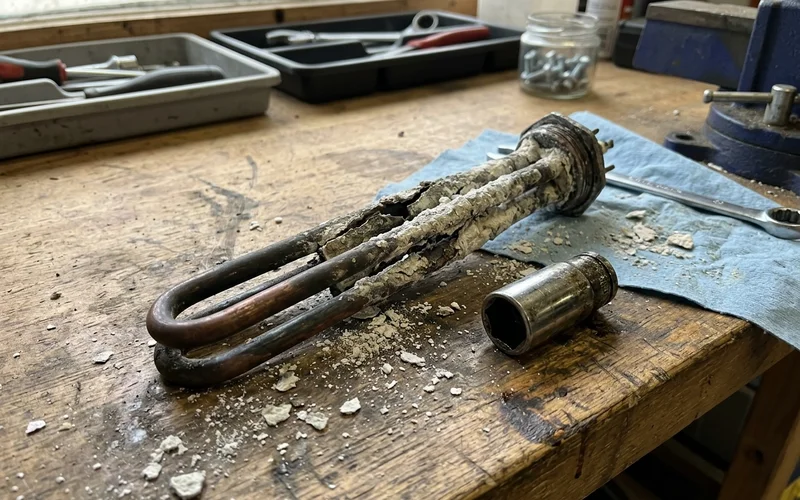
A burnt-out heating element. The most common by a wide margin. The element is a resistive heater immersed in the water, and it fails eventually. Perth’s harder water accelerates it, because scale builds on the element surface, insulates it from the water, and makes it run hotter than designed.
The symptoms depend on your tank. A single-element system with a failed element gives you no hot water at all. A dual-element system that loses the bottom element gives you a small quantity of hot water from the top of the tank that runs out unusually quickly, which is a very recognisable pattern. Losing the top element on a dual-element tank often gives you nothing.
A failed thermostat. The thermostat senses water temperature and switches the element on and off. When it fails, the element never fires, so you get no heat. It can also fail in a way that lets the tank overheat, which is why systems have a separate high-limit cut-out. A thermostat is an inexpensive part and a quick replacement.
A tripped or failed circuit. Covered above. Sometimes it is genuinely the switchboard or the wiring rather than the appliance, particularly on older installations.
The fourth thing worth checking: the anode
If your system is over five years old and the hot water has been looking rusty or tasting metallic, the sacrificial anode rod is likely gone.
The anode exists to corrode instead of your steel cylinder. Once it is consumed, the tank starts corroding internally. That does not directly cause a no-heat fault, but it changes the calculation entirely: there is little sense in fitting a new element to a cylinder that will leak within a year.
We check the anode as part of any service, and it is one of the first things we look at on an older system before recommending a repair.
What we do on site
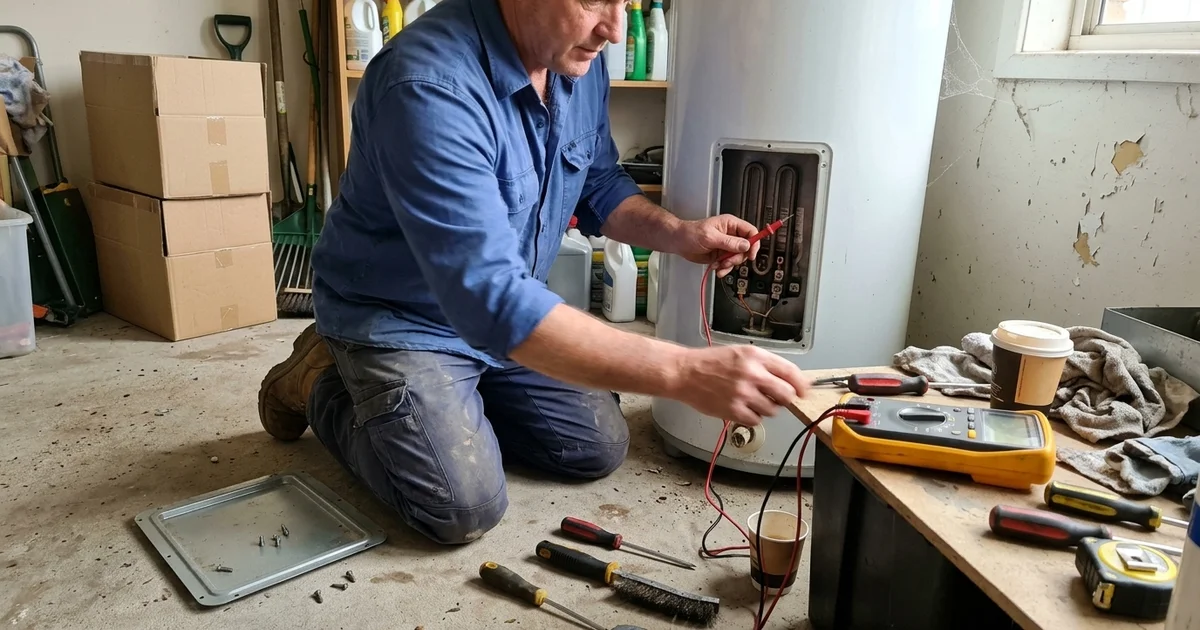
Diagnosis with a multimeter, not guesswork. We isolate the circuit, test the element for continuity and for short to earth, and test the thermostat’s switching behaviour. That takes a few minutes and tells us definitively which component has failed.
Then we look at the tank itself: the anode condition, sediment level, any external corrosion, and the age from the compliance plate. That is the information you need to decide between a repair and a replacement.
Elements and thermostats travel on our trucks, which is why most no-heat calls are resolved on the first visit rather than becoming a return trip.
Repair or replace?
If the tank is under about eight years old and the cylinder is sound, repair it. An element or thermostat is a modest cost on a system with years of life left, and there is no sense replacing a whole tank over a $200 part.
If the tank is over ten years old, already showing rusty water or external corrosion, and this is not the first fault, put the money toward a replacement instead. Our guide on repair vs replacement sets out the rule of thumb properly.
If you are replacing, it is worth pricing a heat pump alongside the like-for-like electric option. It does the same job on roughly a third of the electricity and attracts the federal STC rebate, so the upfront gap is smaller than most people expect.
For repairs, our electric hot water service covers the Perth metro, and our emergency hot water repairs team runs 24/7 for anything urgent.